Insights
The Fault in Our Stars
Akshat Jain · September 9, 2026 · 5 min read
How should you choose a small cap fund? Not by star ratings. Start with a market view, then find the funds positioned to capture it.
The fault, dear Brutus, is not in our stars, but in ourselves. — Shakespeare, Julius Caesar
Cassius meant our failures are our own doing, not the work of destiny. The line survives the change of subject surprisingly well.
Every few months someone sends me a list of small cap funds ranked by recent return and asks which is the best? It is a fair question with an unreliable answer. Over a short window, a ranking of small cap funds mostly measures the risk each was carrying, not the skill of whoever ran it..
There is one exception, and we happen to be living through it: a recovery off a market bottom. That is a situation worth reading closely.
The setup
Small caps bottomed in late March and have risen fairly steadily since. Over the six months that followed, the BSE 250 SmallCap index gained 20–25%.1 Six months is far too short to judge a fund on, and this should not be read as a performance measure. But the period has one useful feature: it was right after a 18 month bear market, almost entirely a one-directional up move with the worst drawdown along the way around five percent. Some funds have been able to capture this up move, while others have lagged.
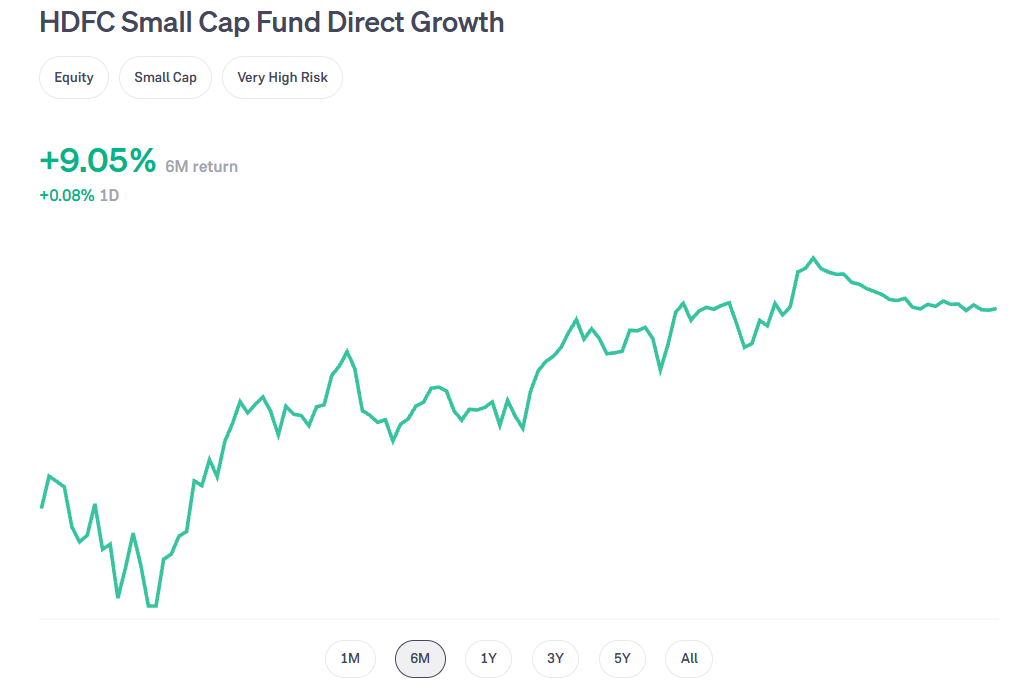
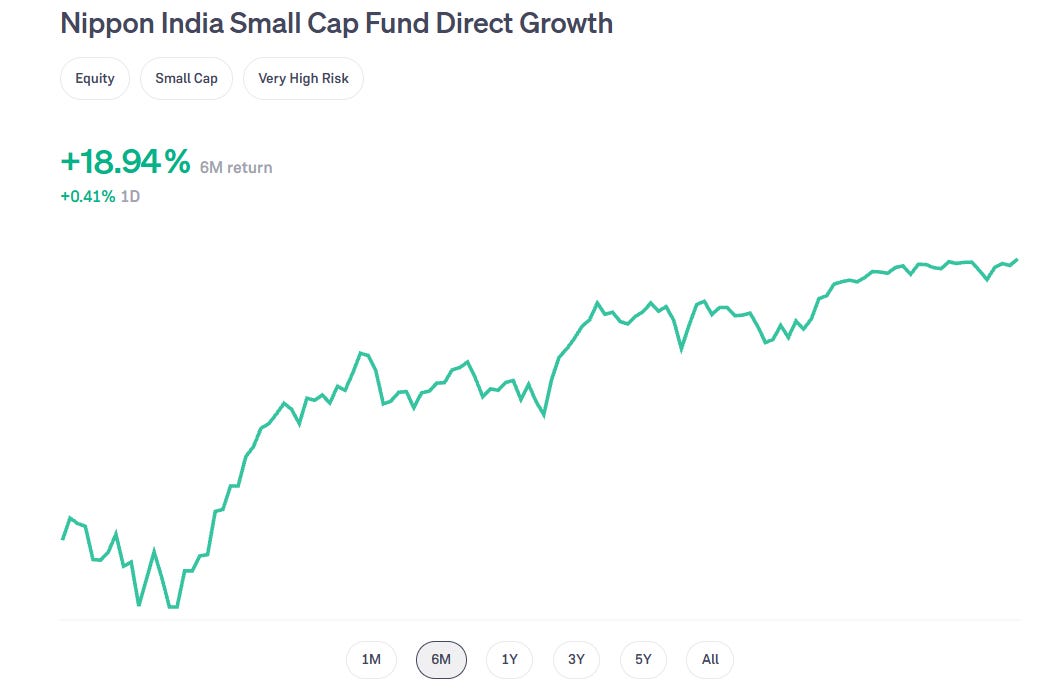
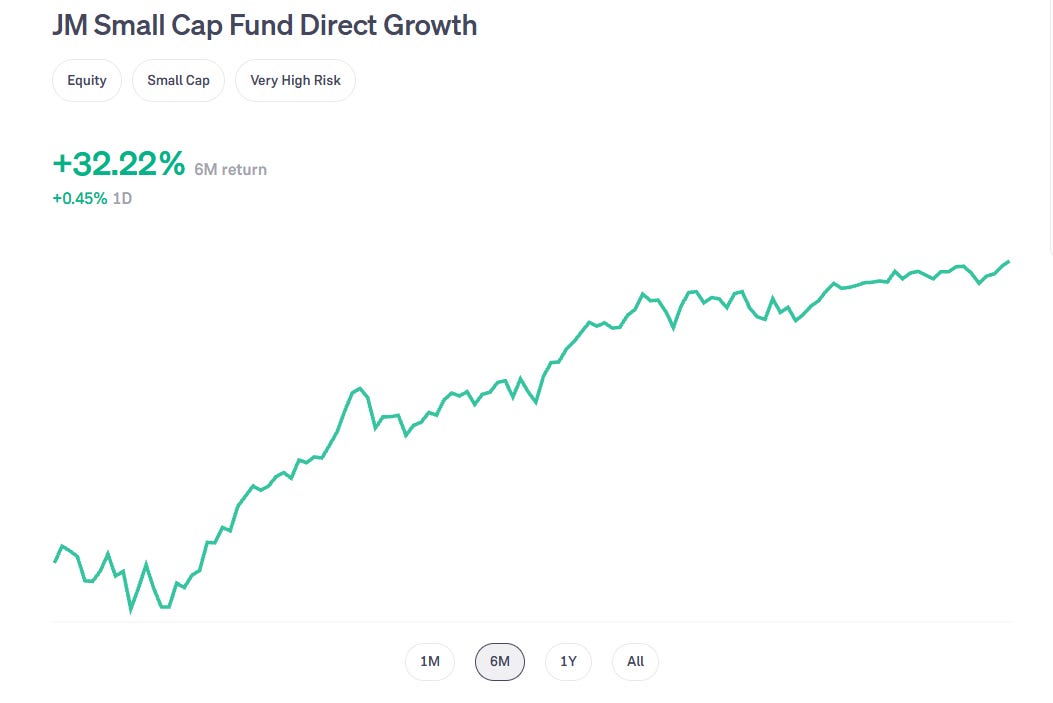
The real question: what's your view on the recovery?
Whether a fund's lag matters at all depends on one thing: what you wanted the fund to do in the first place.
A fund that trails the index in a rally is probably carrying less beta. It holds more cash, probably more mid and large caps, and a broader book. The same fund will typically fall less when small caps correct. Owning such a fund is perfectly reasonable.
So the first question is not whether a fund is good or bad. It is whether the fund's positioning matches your view of small caps from here. If you expect the recovery to run and want exposure to the sharp end of the market, a fund that sits on cash or leans large will work against you, however strong its long-term record.
If you would rather hold small caps but want to take very little risk, then a lower-beta, diversified fund is the rational choice.
What we did with it
In April and May we took the view that large caps would continue to lag, and we took a bet on the small cap recovery as a theme. Once the direction was settled, we looked at three things.
Cash. We wanted funds close to fully invested. A large cash balance can cost in a recovery.
Cap-drift. A small cap fund need only hold 65% in small caps; the rest can sit in mid and large caps. We wanted funds true to their label, closer to 85%+ in small caps.
Size and breadth. Beyond a point, a large fund holding several hundred names simply converges on performance. For a directional bet we wanted something to differ from it.
What the stars miss
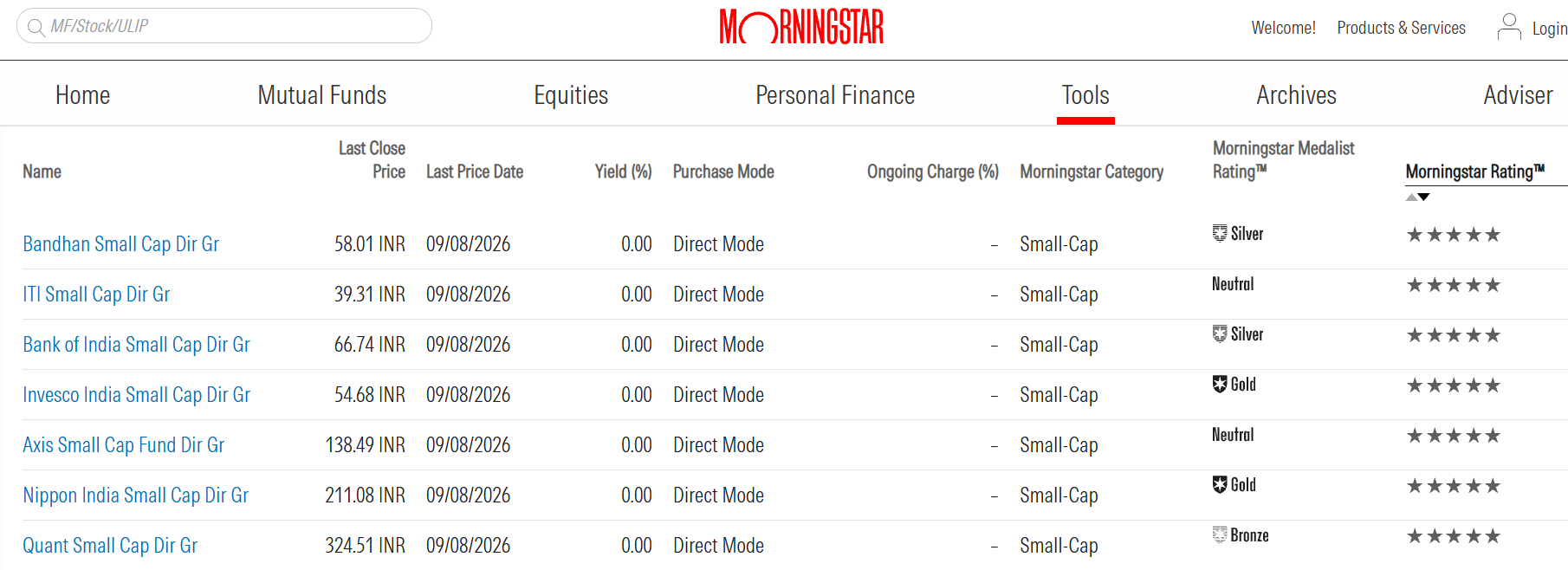
We ran that screen and filtered out two familiar names, despite their five ★ ratings: Bandhan Small Cap and Nippon India Small Cap. Neither is a poor fund. Both are reputable and well run, and both are five-star rated - Nippon carries Morningstar Gold, Bandhan Silver. But a rating condenses years of history into one risk-adjusted figure, and says little about how a fund rides a specific directional move. A fund can be five stars precisely because it is steady and broad, and lag a sharp rally for the same reason. What mattered for our view was how each fund has evolved.
source:morningstar.in
Nippon India Small Cap Fund
Nippon India Small Cap has grown from an AUM of roughly ₹8,400 crore in 2019 to about ₹18,700 crore in 2022, ₹56,000 crore by mid-2024, and close to ₹80,000 crore today. It has long run one of the broadest books in the category, holding exposure to around 270 stocks over three years with a core of about 67. At that scale, breadth is a necessity rather than a preference: as the fund cannot take a meaningful position (> 2%) in companies below ₹15,000 crore in market cap, it has to spread out wide in the liquid parts of the market, which need not necessarily be the best investments.
Bandhan Small Cap Fund
Bandhan Small Cap is younger, launched in February 2020, and has also grown quickly, to about ₹31,000 crore. Its top holdings are heavier than Nippon's, roughly 2.5–3% each in names such as REC, Sobha and LT Foods, but beyond that concentrated core it carries a very long tail - it's holding count is close to 265! It was recently holding close to 10% in cash, despite a stealth bull run.
What did come through were the aggressive, pure-play names - JM Small Cap, Bank of India Small Cap and Trust among them. High small-cap allocations, low median market cap and very little cash. That is the exposure a directional bet would benefit from. Of course, the same traits would sting in a correction, but that's the risk-reward we accepted when we took the view.
Where this leaves you
Fund selection should begin with a view, not a ranking. Decide first what you expect the market to do from here; then filter out which fund is best positioned for it.
A category rating speaks to none of this.
Figures here use the BSE 250 SmallCap on a price basis. The funds are benchmarked to the BSE Smallcap 250 TRI or Nifty Smallcap 250 TRI, both of which are dividend-inclusive. ↩
This is an educational note and not investment advice or a recommendation on any specific scheme. Fund characteristics and ratings referenced are as observed at the time of writing and change over time. Please consult your advisor and read all scheme documents before investing.
Mutual Fund investments are subject to market risks. Read all scheme-related documents carefully. Past performance is not indicative of future results.
Seeco Wealth (Navtantra Retail Private Limited) is an AMFI-registered Mutual Fund Distributor, ARN-302614. This note is for educational and informational purposes only and does not constitute investment advice or a recommendation to buy, sell or hold any scheme. As a distributor, Seeco may receive commission or distribution fees from asset management companies, including those whose schemes are referenced here. Fund characteristics and ratings are as observed at the time of writing and change over time. Please consult your advisor and read all scheme-related documents before investing.